Build the structure every talent decision hangs on.
Define roles, levels, and job families with skills at the foundation — so hiring, development, compensation, and promotion all speak the same language.
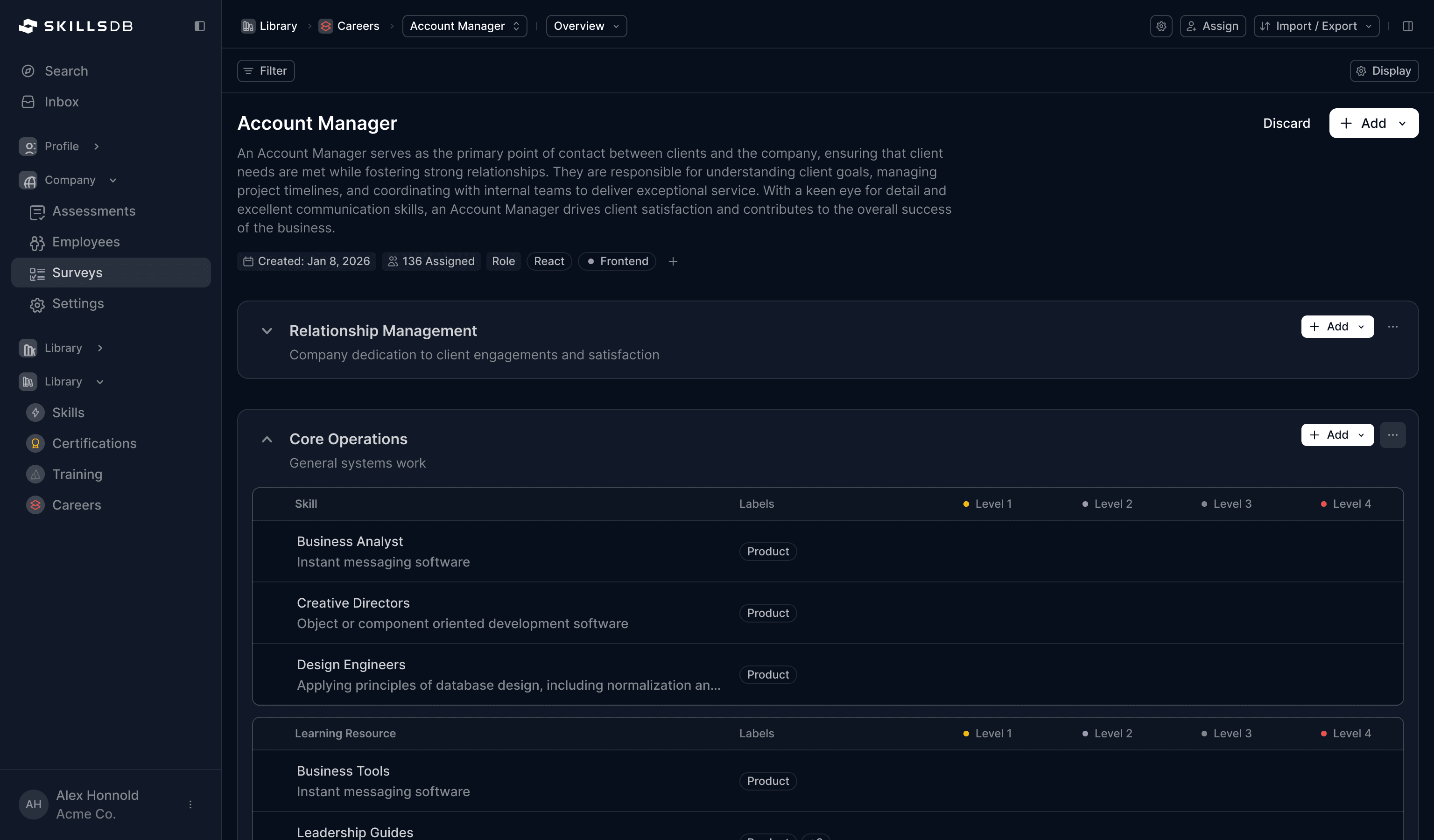
Job architecture is the structural backbone of an organization — but most companies don’t have one. Roles are created ad hoc. Titles inflate without corresponding expectations. Levels mean different things across departments. When someone asks “what’s the difference between a Senior and a Lead?” the answer depends on who you ask.
Without a consistent role and level framework, every downstream decision — compensation, hiring, promotion, development — is built on a shaky foundation. Pay equity audits fail because roles aren’t leveled consistently. Career conversations stall because there’s nothing concrete to point to. Reorganizations take months because nobody knows what the current structure actually is.
What Makes a Skills-Driven Job Architecture Different?
Traditional job architecture defines roles by title and description. SkillsDB defines roles by the skills they require — at every level. Each career has a leveling framework with proficiency benchmarks that increase as employees progress. The architecture isn’t a static org chart exercise. It’s a living structure connected to assessments, gap analysis, and development. The result: when you define a “Senior Engineer,” you’re not writing a job description. You’re specifying the exact skills, the expected proficiency at each level, and the measurable difference between Senior and Lead. Every talent decision that follows has a foundation it can stand on.
Trusted by some of the world's best companies


How It Works
For Talent Development
Define careers with levels, sections, and skills. Set proficiency benchmarks at each level. Every assessment, gap analysis, and learning plan connects back to the architecture.
ExploreFor Resource Planning
Filter the Careers Library by type or label to see which roles are staffed and where gaps exist. Use the Skills Matrix to identify bench strength by level.
ExploreFor Workforce Strategy
A well-structured job architecture makes your workforce searchable and comparable. Assess headcount against capability across functions, tracks, or business units.
ExploreFor Frontline Training
Define frontline roles with explicit skill requirements and training settings per career. Ensure every position has consistent, auditable expectations regardless of location.
ExploreOnly 14% of employers currently underpin their job architecture with skills — yet skills-driven role definitions are what make the architecture useful beyond compensation. The other 86% are building on job descriptions alone.
— Mercer, Global Job Architecture Pulse Survey 2024
SkillsDB has been helping organizations build skills-driven job architectures since 2008. Fortune 500 customers. SOC2 Type II certified. GDPR compliant. 30+ countries served.
Related Features
Career Frameworks
Turn job architecture into employee-facing career pathways with progression visibility.
ExploreCompetency Frameworks
Define the skills and competency standards that populate your job architecture.
ExploreSkills Library
The single source of truth for every skill your job architecture references.
ExploreSkills Matrix
See proficiency across an entire career’s assigned employees in one grid.
ExploreGap Analysis
Identify where employees fall short of the benchmarks your architecture defines.
ExploreSuccession Planning
Use architecture levels and benchmarks to identify who’s ready to advance.
ExploreEvery talent decision starts with structure.
Build a job architecture grounded in skills — not job descriptions — and give every hiring, promotion, and development decision a foundation it can stand on.
Book Demo